La modernité devrait être le lieu de toutes les communications. Jamais l’homme n’a autant communiqué que de nos jours. Presse ordinaire, radio, télévision, sociologie, psychologie, internet, sms, mms, mails divers, que dire, que constater ? La communication est telle qu’on n’en connaît plus le nom.
L’artiste, lui, sait que la communication n’est pas ce qu’en disent les médias. Il sait que la communication n’est pas médiatique ni médiatisable. Il sait aussi qu’avant que de communiquer avec un public quel qu’il soit, il doit communiquer avec lui-même. Connais-toi toi-même, disait l’infaillible Socrate. C’est ce que je crois comprendre à travers l’œuvre, toujours plus serrée, toujours plus parlante et communicante, quant à elle, de Michel Marinus.
L'exposition "Wall with an opening"
Le thème de l’exposition – une ouverture dans le mur –, le cadre esthétique, le choix des œuvres présentées, l’unité des coloris et des personnages, attestent d’une réelle préoccupation de mettre le questionnement artistique en abyme : le mur, l’incompréhension de tous ressentie comme une insulte, la honte du mur, et au-delà du mur, au-delà de l’incompréhension et de l’impossible réponse, quel recours ? Quel regard poser sur la détresse de l’artiste en mal de beauté ?
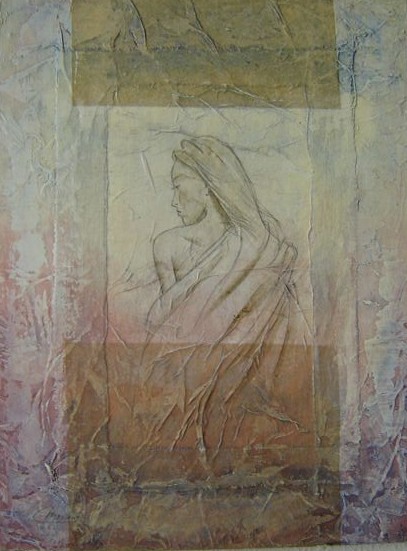
Mais comment accéder à l’objet aimé, par-delà l’obstacle solide de la brique ? Car cet objet qui fait et tend le désir de l’artiste, de tout artiste, est inévitablement muré, emmuré, enclavé. C’est l’inaccessible étoile de Brel, ce sont les lointains nuages de Baudelaire, c’est encore la caverne de Platon. Indicible, inexprimable, insaisissable, la finalité de l’artiste est comme un parcours d’obstacles qui ne se résoudrait jamais. Michel Marinus n’échappe pas à ce lancinant auto questionnement du peintre cherchant dans sa toile une utopique réponse à son utopique question : qu’est-ce que la beauté, où est-elle et comment m’en emparer ?
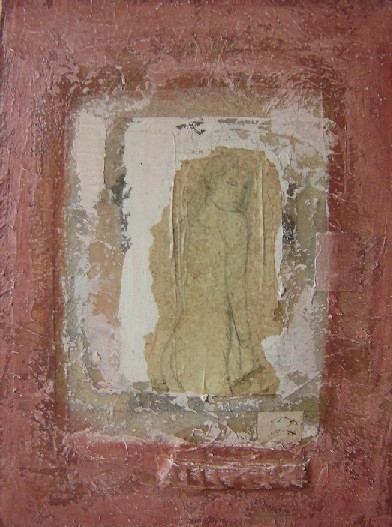
Toujours présente, dans des lignes pures qui contrastent avec la confusion préméditée de son carcan bétonné, la femme de dos (l’admirable Fracturing zone) est saisie par Michel Marinus au crayon et à la sépia avec une infinie délicatesse : adulée, vénérée, révérée, l’aimée et la maudite, tournée de quart, déjà absente, s’impose à merveille sur un fond de cisaillements, de fractures, de déchirures, d’éparpillements. L’objet d’amour est chez lui un peu comme ce rêve matinal et fuligineux de l’Unique, qui nous échappe cruellement après nous avoir si profondément, si durablement investis à notre insu.
Outre l’intelligente technique fusionnelle de collages et de citations (Anisotropy evolution), ce que j’ai particulièrement apprécié et retrouvé dans l’ensemble de l’œuvre exposée, c’est à la fois l’unité des coloris (des rouges, des ocres, des bruns et des bleus à la manière très évocatrice de Pompéi) et celle des personnages féminins. Tantôt hiératique et solitaire, le dos nu et fermé (Walls computations), tantôt séquentielle et drapée, bras tendus, évoluant alors de concert avec une alter-ego dans un univers mystérieux qui pourrait être africain, indien, asiatique, la femme est bien au centre d’une œuvre qui force la méditation. Son impôt de toujours.
A quarante-cinq ans, Michel Marinus a déjà derrière lui un imposant parcours d’expositions collectives et personnelles. Une qualité à épingler parmi d’autres, est certes, s’additionnant à son continuum technique, la variété thématique de ses œuvres, rassemblées d’une exposition à l’autre selon l’inspiration de l’année. L’exposition Wall with an opening, titrée délibérément en anglais, est exemplaire à cet égard, laissant à tout spectateur le souvenir ciblé d’une beauté rouge brique dans la muraille devenue éloquente. On ne saurait trop encourager l’artiste à persister dans sa quête thématique et à y trouver le bonheur lié à toute vraie création. Et la connaissance de lui-même, puisque personne n’échappe à la sagesse socratique.
De moderniteit zou de plaats moeten zijn van alle communicatie. Nooit heeft de mens zoveel gecommuniceerd als vandaag de dag. Gewone pers, radio, televisie, sociologie, psychologie, internet, sms, mms, diverse e-mails, wat moeten we zeggen, wat kunnen we vaststellen? De communicatie is zodanig dat we de naam ervan niet meer kennen.
De kunstenaar daarentegen weet dat communicatie niet is wat de media erover zeggen. Hij weet dat communicatie niet via de media verloopt en er ook niet geschikt voor is. Hij weet ook dat hij, alvorens met welk publiek dan ook te communiceren, met zichzelf moet communiceren. Ken uzelf, zei de onfeilbare Socrates. Dat is wat ik denk te begrijpen uit het steeds strakkere, steeds sprekendere en communicatievere werk van Michel Marinus.
De tentoonstelling "Wall with an opening"
Het thema van de tentoonstelling – een opening in de muur –, het esthetische kader, de keuze van de gepresenteerde werken, de eenheid van kleuren en personages, getuigen van een oprechte zorg om de artistieke vraagstelling in perspectief te plaatsen: de muur, het onbegrip van allen gevoeld als een belediging, de schaamte van de muur, en voorbij de muur, voorbij het onbegrip en het onmogelijke antwoord, welke uitweg? Welke blik werpen op de wanhoop van de kunstenaar die snakt naar schoonheid?
Maar hoe toegang krijgen tot het geliefde object, voorbij het massieve obstakel van de baksteen? Want dat object, dat het verlangen van de kunstenaar - van elke kunstenaar - opwekt en aanspant, is onvermijdelelijk ommuurd, ingemetseld, ingesloten. Het is de onbereikbare ster van Brel, het zijn de verre wolken van Baudelaire, het is nog steeds de grot van Plato. Onzegbaar, onuitsprekelijk, ongrijpbaar, het einddoel van de kunstenaar is als een hindernissenparcours dat nooit zou worden opgelost. Michel Marinus ontsnapt niet aan die aanhoudende zelfbevraging van de schilder die in zijn doek een utopisch antwoord zoekt op zijn utopische vraag: wat is schoonheid, waar bevindt ze zich en hoe kan ik me ervan meester maken?
Altijd aanwezig, in zuivere lijnen die contrasteren met de opzettelijke verwarring van haar betonnen keurslijf, wordt de vrouw op de rug gezien (het bewonderenswaardige Fracturing zone) door Michel Marinus met potlood en sepia met een oneindige fijngevoeligheid vastgelegd: aanbeden, vereerd, geëerd, de geliefde en de vervloekte, kwart gedraaid, reeds afwezig, dringt zich prachtig op tegen een achtergrond van afschuivingen, breuken, scheuren, versplinteringen. Het object van liefde is bij hem een beetje als die nevelige ochtenddroom van de Enige, die ons wreed ontglipt na ons ongemerkt zo diep, zo duurzaam in beslag te hebben genomen.
Naast de intelligente fusietechniek van collages en citaten (Anisotropy evolution), is wat ik bijzonder heb gewaardeerd en teruggevonden in het geheel van het tentoongestelde werk, zowel de eenheid van de kleuren (rood, oker, bruin en blauw op een zeer suggestieve Pompeï-achtige manier) als die van de vrouwelijke personages. Soms hiëratisch en eenzaam, met een blote en gesloten rug (Walls computations), dan weer sequentieel en gedrapeerd, met uitgestrekte armen, evoluerend in harmonie met een alter-ego in een mysterieus universum dat Afrikaans, Indiaas of Aziatisch zou kunnen zijn, staat de vrouw wel degelijk centraal in een werk dat dwingt tot meditatie. Haar eeuwige tol.
Op vijfenveertigjarige leeftijd heeft Michel Marinus al een indrukwekkend parcours van collectieve en individuele tentoonstellingen achter de rug. Een kwaliteit die, naast zijn technisch continuüm, zeker moet worden benadrukt, is de thematische verscheidenheid van zijn werken, die van de ene tentoonstelling tot de andere worden samengebracht volgens de inspiratie van het jaar. De tentoonstelling Wall with an opening, bewust in het Engels getiteld, is in dit opzicht voorbeeldig en laat elke toeschouwer achter met de gerichte herinnering aan een baksteenrode schoonheid in de muur die welsprekend is geworden. Men kan de kunstenaar niet genoeg aanmoedigen om te volharden in zijn thematische zoektocht en daar het geluk te vinden dat verbonden is met elke ware creatie. En de kennis van zichzelf, aangezien niemand ontsnapt aan de socratische wijsheid.
Modernity should be the place of all communications. Never has man communicated as much as today. Ordinary press, radio, television, sociology, psychology, internet, SMS, MMS, various emails, what to say, what to observe? Communication is such that we no longer know its name.
The artist knows that communication is not what the media says it is. He knows that communication is neither media-related nor mediatizable. He also knows that before communicating with any audience whatsoever, he must communicate with himself. Know thyself, said the infallible Socrates. This is what I believe I understand through the increasingly tight, increasingly telling and communicative work of Michel Marinus.
The exhibition "Wall with an opening"
The theme of the exhibition – an opening in the wall –, the aesthetic framework, the choice of the works presented, the unity of colors and characters, attest to a real concern to put artistic questioning into perspective: the wall, the incomprehension of all felt as an insult, the shame of the wall, and beyond the wall, beyond the incomprehension and the impossible answer, what recourse? What gaze to cast on the distress of the artist in need of beauty?
But how to access the beloved object, beyond the solid obstacle of the brick? Because this object which creates and tensions the desire of the artist, of any artist, is inevitably walled in, immured, enclosed. It is Brel's inaccessible star, it is Baudelaire's distant clouds, it is still Plato's cave. Inexpressible, unutterable, elusive, the finality of the artist is like an obstacle course that would never be resolved. Michel Marinus does not escape this haunting self-questioning of the painter seeking in his canvas a utopian answer to his utopian question: what is beauty, where is it, and how do I grasp it?
Always present, in pure lines that contrast with the premeditated confusion of its concrete straitjacket, the woman seen from behind (the admirable Fracturing zone) is captured by Michel Marinus in pencil and sepia with infinite delicacy: adulated, venerated, revered, the beloved and the cursed, turned a quarter, already absent, imposes herself marvelously against a background of shearing, fractures, tears, scattering. The object of love is for him a bit like that misty morning dream of the Unique, which cruelly escapes us after having so deeply, so lastingly invested us without our knowing.
In addition to the intelligent fusion technique of collages and quotes (Anisotropy evolution), what I particularly appreciated and found throughout the exhibited work is both the unity of the colors (reds, ochres, browns, and blues in a highly evocative Pompeian manner) and that of the female characters. Sometimes hieratic and solitary, the bare and closed back (Walls computations), sometimes sequential and draped, arms outstretched, evolving in concert with an alter-ego in a mysterious universe that could be African, Indian, Asian, the woman is indeed at the center of a work that forces meditation. Her eternal toll.
At forty-five, Michel Marinus already has an impressive background of collective and personal exhibitions behind him. A quality to be highlighted among others is certainly, adding to his technical continuum, the thematic variety of his works, gathered from one exhibition to another according to the inspiration of the year. The exhibition Wall with an opening, deliberately titled in English, is exemplary in this respect, leaving any spectator with the targeted memory of a brick-red beauty in the wall that has become eloquent. We cannot encourage the artist enough to persist in his thematic quest and to find there the happiness linked to any true creation. And the knowledge of himself, since no one escapes Socratic wisdom.